
Let's talk about Matt LaFleur's 4th down decision
Another game, another Packers collapse. It’s getting kind of familiar, isn’t it?
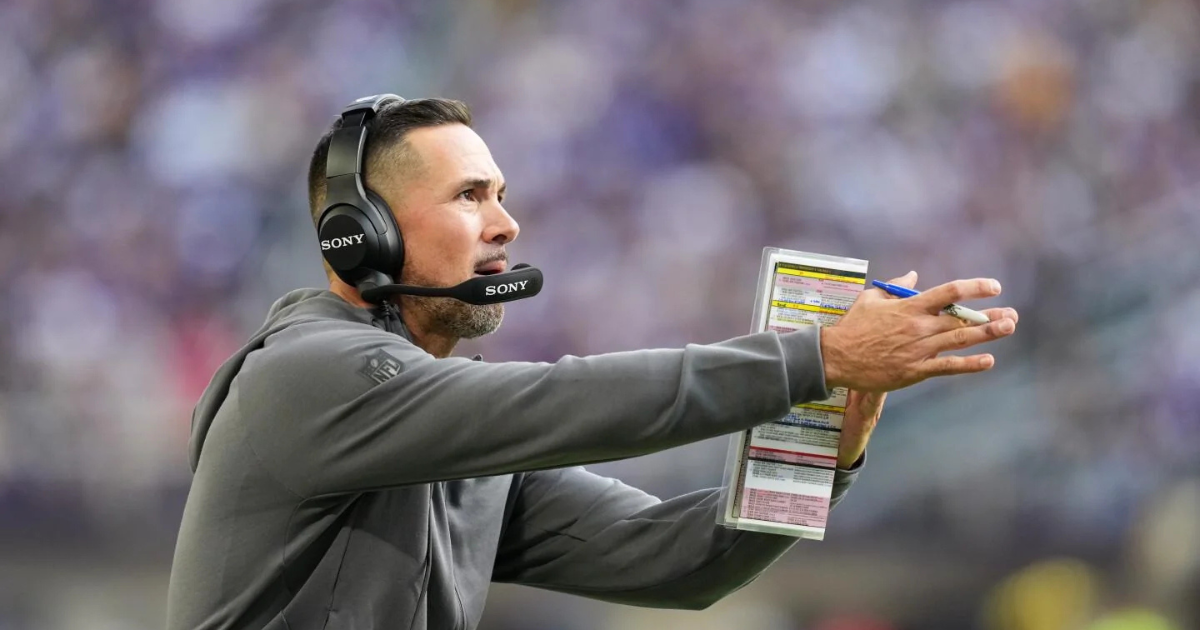
Much, if not all, of the blame for the Packers’ most recent collapse (a chilling phrase) seems to be landing on Matt LaFleur today. Specifically, LaFleur is catching heat for his 4th quarter decision to take a 40-yard field goal off the board in favor of attempting a 4th down quarterback sneak, which failed. The Vikings subsequently took the ball and marched down the field for the go-ahead touchdown and never surrendered the lead.
I think LaFleur’s decision was defensible, even if it failed. I’d even go as far as saying it wasn’t just defensible; it was correct. But as much as I may have attempted to explain that on the postgame podcast, I wanted to pull on the thread a bit more after getting a few questions about it overnight. So let’s slice and dice this play and see what we come up with.
Let’s talk about momentum
The biggest complaint about LaFleur’s decision and its subsequent failure centers on the idea that it gave the Vikings momentum. That argument presupposes that momentum exists and has a meaningful effect on games. Does it?
Scholarly research suggests it might, but I am unconvinced. I’ve reviewed quite a few scholarly studies on momentum, and generally, statisticians seem to believe it exists. But their definitions of momentum are very different from what fans typically seem to mean by momentum.
My impression is that fans view momentum, such as it is, as a forward looking phenomenon. This team now has the momentum, therefore good things are going to happen for them. Momentum, as conceptualized in this sense, can’t really be measured or predicted and probably only comes up because you remember moments where a series of good things happened (or, just as likely in the Packers’ case, a series of bad things) and that led to an ultimate good or bad outcome.
But scholars don’t view it that way. Here’s a selection of papers on the subject and a couple of thoughts about each:
This 2022 paper from University of Wisconsin researchers posits that momentum is real, but is represented by shifts in win probability, and only in hindsight. You can’t predict what will give you momentum, you can only identify in hindsight when momentum swings have happened. But doing things that increase your win probability is a fundamentally different thing than the typical fan conception of momentum; that’s just playing football! Everybody wants to do those things, and there’s no nebulous “momentum” attached to decisions that lead to it. You don’t make different football decisions because you do or do not have momentum. Tellingly, they argue the Falcons’ 28-3 Super Bowl collapse was actually not an example of momentum.
This 2025 paper from a grad student at Eastern Washington University argues that momentum is real, but “can be gained or lost at any time.” If you can gain or lose it at any time, momentum is useless. What’s the point in having it if it doesn’t lead to more? Why would you want to try to get momentum? Again, this is just making good football decisions.
This 2019 paper from researchers at the University of Virginia and the University of Singapore also argues that momentum exists, but can only be identified in hindsight, and typically occurs in momentum episodes within periods. What are those? “Momentum was considered to ‘start’ after two ‘unanswered’ scoring episodes occurred such that the magnitude of the momentum indicates the number of points earned or lost during the second scoring episode plus all points earned or lost in subsequent scoring episodes of the same trend. WE chose to allow momentum to ‘start’ after the second scoring episode to maintain consistency with our definition of momentum as a ‘systemic and sustained trajectory in performance over time.’” If that’s the definition, the Vikings wouldn’t have had momentum until after they scored the touchdown that put them ahead after the Packers’ failed 4th down conversion. The Packers’ 4th down decision didn’t give the Vikings’ momentum. The outcome of the next drive did.
Each of these definitions banks heavily on win probability which, again, is a lot more of a concrete term than what I perceive as the typical fan definition of momentum. So let’s look at two other categories by which to evaluate the decision: win probability itself and available outcomes.
What does win probability say?
Football statistician Ben Baldwin has a nifty tool that evaluates every 4th down decision based on years of statistical data. You can follow it on BlueSky or evaluate it yourself at rbsdm.com. What did it have to say about the Packers’ decisions?
Prior to the penalty, the Packers faced a 4th and 6 from the Minnesota 22-yard line. Baldwin’s bot strongly recommended the Packers’ kick a field goal there, saying that doing so (and, obviously, making the kick) added 5.1% to the Packers’ win probability total.
But after the penalty, the Packers faced a 4th and 1 from the Vikings’ 17-yard line. Baldwin’s bot gave the Packers a medium recommendation on a kick, saying that doing so (and, again, making the kick) added just 1% to the Packers’ win probability total.
Analytically, there is therefore some support for the idea of kicking it. But what was at stake?
What were the available outcomes for the Packers?
Bill Walsh famously argued that all football is situational, so to get a real grasp of what the Packers had to think through, let’s look at the situation and the Packers’ goals.
The Packers had the ball deep in Vikings’ territory near the start of the fourth quarter. Their goals for the drive were simple: increase the lead however possible, burn as much clock as possible, and score a touchdown if possible, all of which would make it more difficult for the Vikings to stage a comeback.
Facing a 4th and 1, the Packers had to decide whether kicking it or going for it supported those goals more strongly.
Should they have chosen to just kick (or, rather, keep the kick they’d already made), they would have been resting on the fact that they increased their lead in such a way that would force the Vikings to score a touchdown and a two-point conversion to tie. They couldn’t put the game away, but the door they left open was still a fairly challenging one for the Vikings to walk through.
But it’s not like there was nothing to gain, either. By choosing to go for it, the Packers were hoping to increase their lead to at least eight points (through a field goal that should have been essentially a sure thing), get a chance to burn more clock, and get a chance to increase their lead to as many as 12 points. A 12-point comeback would have necessitated two touchdowns.
Put differently, converting the first down gave the Packers a chance to hit all of their goals (increase the lead, burn clock, score a touchdown if possible, therefore making a Vikings comeback more unlikely). However, it also put the possibility of a Vikings’ lead in play; if the Packers tried for the 4th down conversion and failed, the Vikings could take the lead with a touchdown. They did, of course.
But there was also good reason to assume the Vikings probably wouldn’t be able to sustain a long drive. Prior to the 4th down failure, the Vikings had gained more than four yards on five three of their nine drives, and more than 15 yards on just three. There was really good reason to assume that whatever the Vikings did on their next drive wouldn’t result in points since the Vikings probably wouldn’t have been able to sustain a drive. And but for stripe-oriented interference, they wouldn’t have! Penalties negated a third down sack, a third down incomplete pass, and a third down interception. If momentum is real, I’d argue all of those gave the Vikings more momentum than anything the Packers did in and of themselves.
And for what it’s worth, that idea is analytically well supported: three of the Vikings’ four biggest plays in terms of win probability added were a 28-yard Jordan Mason run (which happened the next play after Chris McClellan’s roughing the passer call), Xavier McKinney’s holding call that wiped out Evan Williams’ interception, and McClellan’s roughing the passer call itself. Momentum, it seems, arrives in black and white stripes.
The bottom line
I understand those who disagree (and I’ll extend you an olive branch here in a second, bear with me), but I think I’d rather lose doing what LaFleur did than kicking the field goal and hoping. I want to go down shooting, and I feel like the positive outcomes of going for it outweigh the potential downsides, especially given how hard it should have been for the Vikings to get down the field and score.
Granted, it should still have been hard for the Vikings to get down the field and score with the Packers up eight points instead of five, but LaFleur has been criticized in the past for trusting in his defense too much and not being aggressive. He seems damned either way!
Here’s my olive branch: I think there’s enough evidence in LaFleur’s recent history that suggests he probably shouldn’t be judged on process, even if you can make (what I think is) a strong case for that process being correct. I spent a lot of time on my recap podcast talking about process versus outcome, but the sneaky thing with that kind of discussion is that outcomes are all that ultimately matter. A good process should yield good outcomes more often, but that’s a long-run proposition, and I don’t think LaFleur is in a position right now to get judged by the long run. He needs results, and quickly, and if he’s going to take risks, they need to pay off. It’s not good enough to just be analytically sound or strategically defensible anymore. It has to work.
And no matter how strong of a case I make, LaFleur’s call didn’t work on Sunday.