
Most Interesting Prospects 2026: Cincinnati WR Jeff Caldwell
I think a lot of NFL Draft analysis tells us more about the analyzer than the prospect. I’m not just talking about cliches and repeated phrases, the “here’s a guy” and “on my board he’s” every analyst uses, their biases and preconceptions.
I mean it this way: in their analysis, a lot of people who talk about the NFL Draft are telling us what they believe they would be like as a prospect if they’d merely been blessed with the athletic gifts required to be a professional athlete.
You see this particularly clearly with a player who is blessed with exceptional athletic gifts, even relative to other would-be professional athletes. The train of thought on these players quickly focuses on one question: how dominant are they?
It’s no longer enough for a player to be merely good. He must be great. He must be exceptional, because he already is exceptional in one very specific way.
And I can’t help but read personal projection into these criticisms. When an analyst criticizes a player, especially one who may have played at a smaller school, for not dominating their competition, there’s an implicit “but” in every statement. “So and so is an exceptional athlete who didn’t necessarily dominate at his level of competition…but I would have. Had I been blessed with his physical dimensions, with his speed, with his leaping ability, there’s no end to what I would have accomplished.”
The mask really slips when the player in question actually was dominant. “Well, yes, he was great, but he’s not really a refined player,” analysts will inevitably say. “He hasn’t developed his craft, because he hasn’t needed to.”
This is undoubtedly true. There are numerous examples of players who were great in college but failed in the pros simply because they never had to learn to play football; they could just out-athlete everyone…until they couldn’t. But it’s a false criticism, at least for a college athlete, because if you could win one way and nobody could stop you, why would you bother to learn how to win another way? If you were faster or stronger than every one of your opponents, why bother learning to become more skilled as well?
Unless they’re really saying “He hasn’t developed his craft, because he hasn’t needed to…but I would have. I would have become a complete player. I would have honed the little details even when I didn’t have to.”
I carry all this into my evaluation of Cincinnati’s Jeff Caldwell, one of the greatest recent examples of these phenomena that I can recall.
Caldwell is an unusually gifted athlete. I’ve just criticized other analysts for projecting, but allow me to do it for a second: I’d give a great deal to experience what it’s like to be an athlete of his caliber. Caldwell stands 6-foot-5 and weighs 215 pounds, and from what I can tell, the vast majority of those 215 pounds is rippling muscle. He ran the 40-yard dash in 4.31 seconds, which would be a tremendous time for a man six inches shorter and 30 pounds heavier. His testing numbers at the NFL Combine placed him in the 99th percentile for virtually every event he attempted, and at least one of his performances, the broad jump, was as many as seven inches shorter than his previous reported best of 11 feet, nine inches. Imagine that: with a chance at impressing the people who will determine your football future, the best broad jump you can muster is merely 11 feet, two inches.
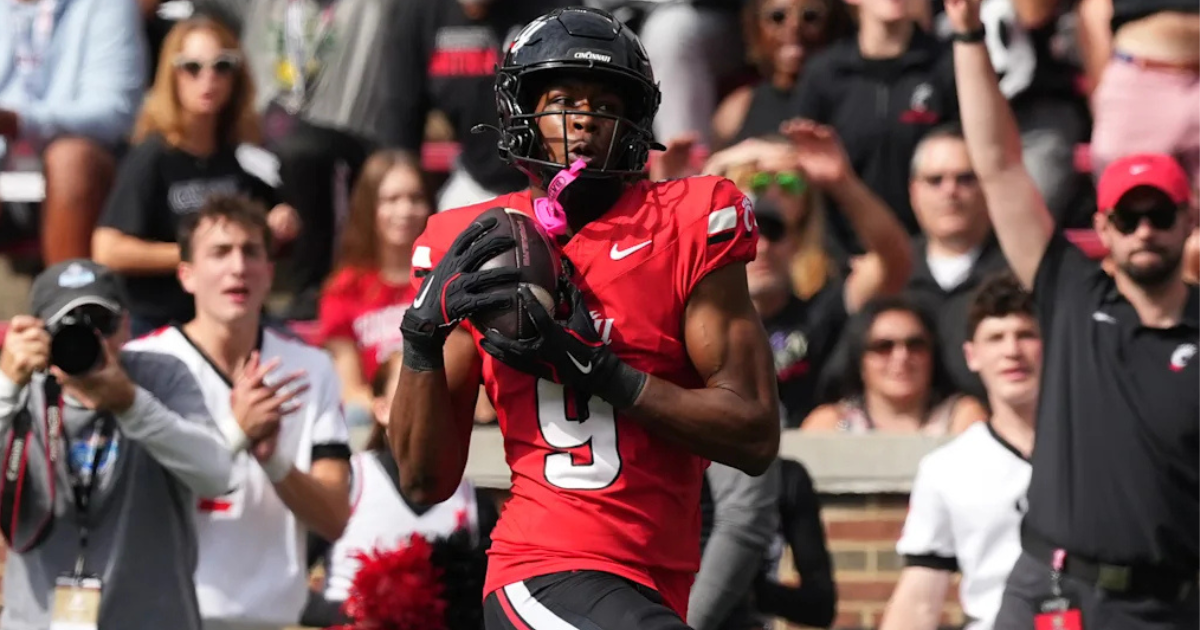
Caldwell played just one year of big-time college football, lining up for the Cincinnati Bearcats last fall, and in that season he flashed the athleticism that makes him a unique prospect while also showing the lack of refinement that people criticize. Despite being almost certainly the best athlete on the field every time he lined up, he managed just 32 catches for 478 yards and six touchdowns. Nothing to sneeze at, to be sure, but more than enough evidence for the type of analyst who likes to point out a lack of polish in a prospect’s game — correctly, I should add, in this instance.
But prior to Cincinnati, Caldwell was a dominant performer. He averaged more than 19 yards per catch over his three year career at tiny Lindenwood University, and put up a ridiculous stat line of 53 catches for 1,032 yards and 11 touchdowns his final season there. 19.5 yards per catch is above criticism at any level, no matter how you’re getting it.
That, of course, puts Caldwell right into the trap of criticism we’ve talked about: he dominated, but only through his incredible athleticism. And when facing better athletes, he showed his lack of refinement.
The troubling thing is, this is the correct opinion. He isn’t a refined player. He isn’t ready for NFL success. Yes, he’s a terrific athlete, but for every super athlete that turns into a reliable NFL player, there are many more who are merely blips on the historical radar. Just because he’s an incredible athlete doesn’t mean he’ll develop into anything.
But what an athlete he is, and therein lies my interest. It’s true, he may never develop into anything. He may never become a Pro Bowler or an All-Pro or harness his athletic gifts to become an unstoppable force. In fact, it’s more likely than not that he won’t.
But I don’t watch sports to witness the optimal outcome. I don’t watch sports to wonder what I might have done in a particular situation or what I could do if I were built like a Greek god and could run like a superhero. I watch to see things I’ve never seen before, and one of the surest ways to do that is to track down the people who can do rare things.
Caldwell is one such person. He’s already achieved so much just by reaching this level of athleticism — in some ways, criticism about reaching his potential is just wrong on its face, because how much untapped potential could he have? He can already run faster and jump higher than pretty much everyone. He can do rare things, and he’s a rare prospect. And as someone looking for things I haven’t seen before, he’s already given me exactly what I want.