
Rough Magic: Bill Walsh’s Return to Stanford Football
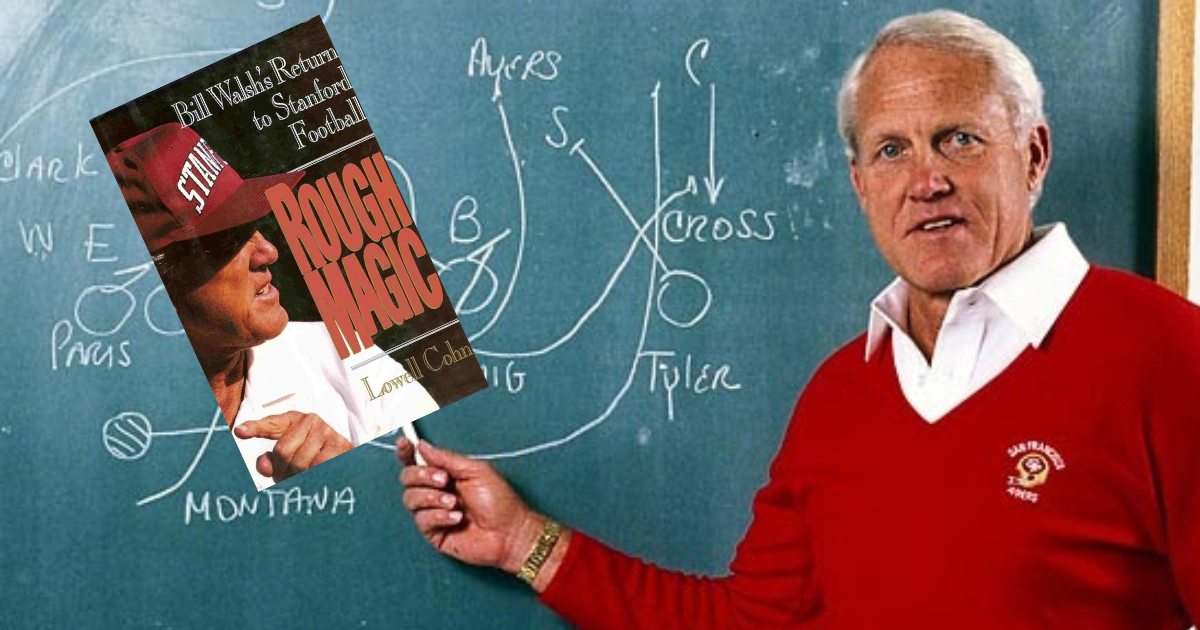
I’m going to go a little bit out of sequence with this one and say what I think right up top: this book is incredible. I read more than 60 books last year and this was in the top five. It is genuinely great. My challenge here is to explain why.
In the midst of his epic late-career dispute with the Green Bay Packers, Aaron Rodgers summed up his take on teambuilding pretty succinctly.
“It’s just kind of about a philosophy and maybe forgetting that it is about the people that make the thing go,” he said. “It’s about character, it’s about culture, it’s about doing things the right way.”
At its core, Rough Magic is a book about people.
The first person it’s about is, of course, Bill Walsh. He’s one of the greatest football coaches of all time, but why? What makes him great? Rough Magic doesn’t explain that to us, but shows us Bill Walsh’s attempt to figure it out himself as he returned to coach Stanford football in 1992. In the book, he’s headed back to Stanford after a few years out of the coaching game, having walked away from his San Francisco 49ers at the pinnacle of success. Walsh is trying to see if he can do it all again, and the expectations were high.
A Stanford booster said this of the hire: “We were looking for Moses to lead us out of the muck and mire, and we got God.”
So who were they hiring? Most of the book is, in one way or another, about exploring that question. Who was Bill Walsh? Author Lowell Cohn, writing with great, perhaps even unprecedented access to the Stanford football program, has a few answers.
For starters, Walsh is a hard-nosed guy who grew into an intellectual, a former boxer that Cohn said didn’t realize the irony of where he’d ended up.
“He could not see the paradox in his position, that he was a man in a war game who was ashamed he’d been a fighter.”
Walsh was also a dreamer and football die-hard, someone so devoted to the game that everything else would melt away when he was focused on football. Cohn writes that at Stanford, Walsh constantly had trouble balancing his schedule. The demands were intense: in addition to his typical obligations as the coach, he had to be a figurehead for the athletic department and Stanford as a whole, making appearances for boosters and non-sports media as the university used him as a part of its fundraising apparatus. This did not suit Walsh, and Cohn says that’s because he was used to living in his own world of Football Time.
“With Walsh there were two kinds of time. Regular Time was what people like [his assistant] Jane Walsh tried to get him to conform to. He would sometimes adhere to regular time — always when there was a team meeting or a team bus or a plane to catch — but he felt confined by Regular Time.
“Then there was Football Time, which stretched endlessly in every direction, was plastic, had no beginning and no end. Football Time was where he chose to live as much as possible. It was the world of the mind, a land of pure creation in which an hour might feel like a minute. When he was in Football Time Walsh was happy. He was beyond happy. If anyone went into his office when he was in Football Time, he would glance up from what he was doing like an absent-minded professor — which in many respects he was — and he might nod to the guest and invite him in. He was reflexively polite. The guest might say something and Walsh would nod. But he wouldn’t hear. He was elsewhere, lost in the permutations of plays, running some new wrinkle from four or five different formations. It would be the job of the guest to understand that Walsh was being polite, but that he did not want to come back to Regular Time at that moment. It would be the guest’s job to leave.”
Walsh seemed to be happiest in football time because there he could do what he really wanted to do: create art via football. Cohn writes that Walsh viewed himself as competing against an idealized version of himself, or maybe an idealized version of football. He was chasing perfection, and only in Football Time could he find it — if he ever did. In the book, Walsh seems tortured by the gap between who he is and who he wants to be, even when things are going well.
After a late-season victory over Cal, Cohn finds Walsh all but alone in the locker room. Stanford had, at one time, led the game 31-3, but a sloppy finish had opened the door for Cal making the game appear closer than it actually was. There was no threat of losing, but Walsh’s team had lost its chance at putting together a dominant win.
“Everyone else dressed and went out to the buses. Walsh lingered. He changed into his street clothes, tied his shoes, then knotted his tie. ‘It was almost a perfect game,’ he said to someone who’d stayed with him. He began to leave, but abruptly sat down again. He couldn’t get over the ending. It was as if someone had substituted a Three Stooges movie for the last act of Hamlet. ‘It loses its artistic sense,’ he whispered. ‘Now it’s not a thing of beauty. It’s just a victory.’”
With Walsh in this headspace, the roles of the other people in the story become easier to understand. Walsh rarely explains himself; all of his art makes perfect sense to him. But it confuses others, like Terry Shea, a former head coach at San Jose State who’d jumped to Stanford for the chance to work under Walsh — only to find himself struggling to adapt to Walsh’s immense, complicated playbook.
“Shea’s problems with terminology ran deeper than colors. He could discover no rhyme or reason for the names of Walsh’s plays. The creative fountain in Walsh’s brain always was bubbling, and just as fast as the plays came, Walsh would assign names to them. Double post, for example, was a Dino. Why? It just sounded good. The Stanford playbook was crammed full of Bims and Bams and Bobs. It had a Bingo Cross, a Shallow Cross, an Okie, a Hank, Dragon, Drift, Texas, Knife, Cowboy, and Denver. At first, Shea tried to reason all this out to find the hidden order in the nomenclature. When Walsh realized Shea was doing that, he had to explain that there was no hidden order. It was a matter of committing the entire organism to memory. So no wonder Shea felt overwhelmed — here he’d spent his whole life in football, had been a successful coach, and sometimes had only the vague notion what Walsh was talking about.”
And if the football side was hard, the office politics were harder. Walsh, in addition to being a football genius, was a deft manipulator of people. The machinations of Walsh’s coaching staff resemble a high-level game of political chess, complete with courtly intrigue. Rather than say what he thought directly, the Walsh of the book frequently turns to backhanded compliments and sidelong remarks to get what he wants, such as in one instance when he was dealing with an offensive line coach he didn’t particularly like — despite having hired him.
“Walsh wanted to motivate Scott Schuhmann to get more out of his players, and he was getting the message across through the players, believing that Schuhmann was savvy enough to know what was going on. The attack became almost brutal when Walsh criticized center Glen Cavanaugh for going the wrong way on several plays, then added ‘I don’t know, maybe you were told to do it.’ This was a direct assault on the coach in front of the entire team. If Cavanaugh had been taught to do the wrong thing, Schuhmann had done the teaching.”
Between the football genius and the moving of people, it’s easy to see why Walsh is one of the great coaches of all time, and it was actually troubling for me to read about him. That’s one of the reasons I resonated so much with the book: I can’t see myself as the hard-driving, win through effort and grit coach that Vince Lombardi was, so “When Pride Still Mattered” doesn’t come across as a cautionary tale for me. But I can see hints of Walsh’s inner life reflected in me, his constant self-doubt, his competition against an idealized version of something, and, frankly, his constant worrying — and that means the book is an interesting cautionary tale.
Oh, and it’s great on the football parts of the book, too. I’ve rarely come across a work of sports that so thoroughly and accurately recounts what went on in individual games or even on specific plays as this one. Plenty of sports writers play a bit loose with the facts to get across the story they want to tell about a specific play, but not Lowell Cohn. He artistically describes the games he watched, but never at the expense of the facts.
The 3N Test
That’s my case for the book. How does it hold up against other would-be members of our football canon? Let’s run it through our 3N test to find out.
As a reminder, the three Ns in the 3N Test stand for “novelty,” “nuance,” and “narrative.” We’ll rank each of those on a scale of one to 10, and on a cumulative score of at least 20, we’ll induct the work into our canon of football books.
“Novelty” is how unique the work is, and I have to admit, this is not the most unique work out there. There are plenty of other books that cover a day or a week or a year in the life of a sports team. They may not do it as well as this one, but they’re out there. I’ll give Rough Magic a 5 out of 10 on the “novelty” scale
But from there, things get a lot better. “Nuance” reflects how well the book handles its subject, and I’m giving this book a perfect 10 out of 10 on that scale. Cohn is tough on Walsh, but fair. He praises him and criticizes him. He seeks alternate opinions on just about everything, and he does it all in what amounts to “real time.” The book never bogs down. It’s a perfect handling of a complicated subject. I don’t think anything was left out here.
And finally, “narrative” rates the actual writing of the book. I’m going with another 10 out of 10 here. Cohn’s writing is beautiful, poignant, and frequently very funny. Consider this glib little bit about an altercation between two players during a late-season game:
“Early in the fourth quarter, Cardinal cornerback Darrien Gordon slugged Huskies receiver Jason Shelley in full view of the 70,281 spectators in the stadium. Shelley was a freshman and had been waving his arms and celebrating all day, and some of the Stanford veterans thought he was in bad taste. The officials thought Gordon was in bad taste and ejected him from the game.”
There is a ton of reporting and nifty writing baked into those three sentences: two player names, the attendance, background about who the two players involved were, and what the officials did about it. That’s a writer who’s feeling it. In a worse book, that kind of line might stick out as trying too hard, but Cohn rips off many such bits.
That gives us a bottom-line score of 25 out of 30, easily enough to get Rough Magic into our football canon. If you love football history, want an in-depth exploration of one of the great coaches in modern times, and value great writing, give this one a look.
Scorecard:
Novelty: 5 out of 10
Nuance: 10 out of 10
Narrative: 10 out of 10
Overall: 25 out of 30
Up next, we’re going off the map with a look at something that’s more textbook than literature: Steve Belichick’s Football Scouting Methods is coming up.
Notable quotes
“‘I’ve lost something. I know that. I’m just not sure what,’ he told someone observing practice. ‘Maybe it’s because I’m sixty. I don’t know. I’m nervous. I admit that.’” - Walsh early in his Stanford tenure
“As the team worked out, Walsh walked around the perimeter of Notre Dame Stadium, a sixty-thre--year-old structure made of tan brick. The Irish media guide will inform you there are more than two million bricks in the building, not to mention four hundred tons of steel and fifteen thousand cubic yards of concrete. The stadium seats 59,075, but twice that many would come if Notre Dame ever decided to enlarge the seating capacity. The stands are right on top of the field, and temporary seats are installed near the end zone. Anyone who runs a sharp corner route at either end is likely to fall into the lap of a spectator.”
“As time went by, Walsh became the Bengals’ offensive coordinator, although [head coach Paul] Brown never gave him that title. Walsh would call the plays from the press box, and Brown would repeat them on the sideline to give the impression he was making the calls. Sometimes, Brown would botch the plays and he’d become offended when the players shouted, ‘Well, ask Bill what he means.’”
“If you see a guy suffering from euphoria, kick him in the ass.” -Walsh on the need for focus ahead of a big game
“Ellery Roberts felt edgy, too, but he wasn’t sure why. From the time he woke up, the day seemed to be going in fast motion. He’d gone to breakfast and boarded the bus and arrived on campus — all too fast, everything out of control. It was as if he were living a dream. And now he was on the sideline with the game about to begin, and he didn’t feel ready.”
“An error is not a mistake until you refuse to correct it.” - A snippet of assistant coach Fred von Appen’s coaching philosophy
“[Fred] VonAppen was closing in on fifty, and he had begun to think in an abstract way about loss. By the end of the day, his sense of loss would be immediate.”
“During games, [offensive lineman Steve Hoyem] constantly fought against dehydration, and after the scene in South Bend, getting an I.V. on the floor while water from the showers sloshed against his prone body, the team doctors had decided to head off any problems by regularly giving him an I.V. at halftime. Hoyem had learned to accept suffering as the price he paid to pursue his passion.”
"So many coaches had come and gone in Walsh's life that he could barely keep track of them. Sometimes they all seemed to meld together into The Opponent."
“On that play, [quarterback Steve] Stenstrom was supposed to look for a blitz, and if one was coming, he had to call an audible. Failing that, he was expected to get the ball to what Walsh had called a ‘hot’ receiver or a ‘blitz beater.’ But Stenstrom hadn’t practiced all week and was blissfully unaware of the intricacies of that play. It never once crossed his mind to consider what Demetrius DuBose might be doing at about 12:37 p.m. that afternoon.”