
The Education of a Coach by David Halbersta
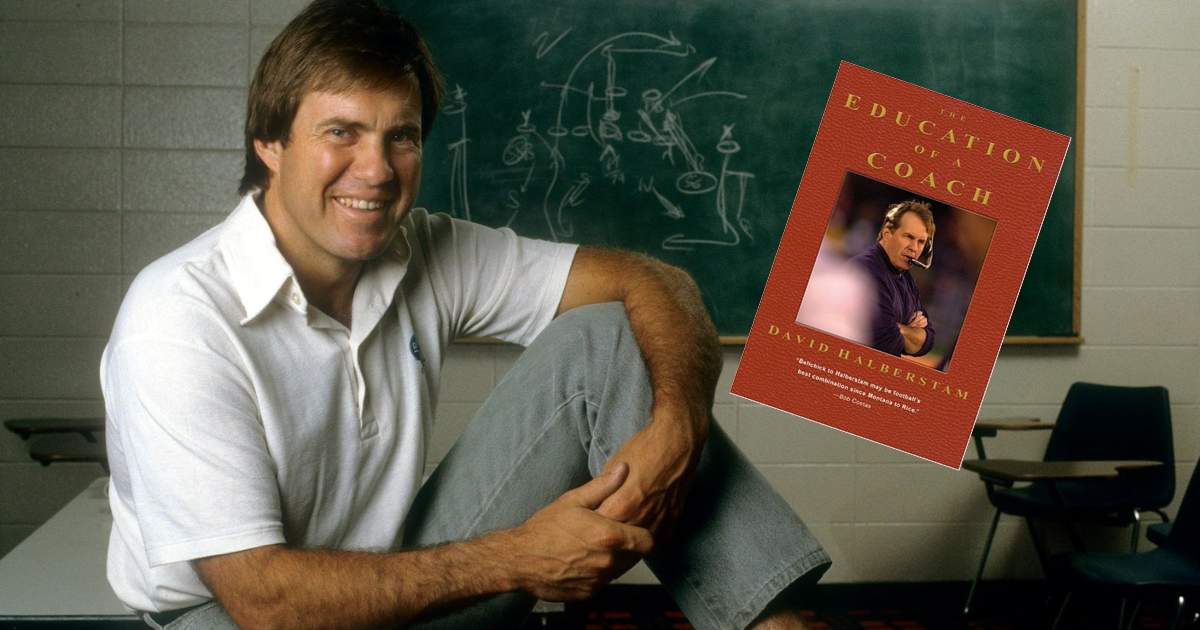
Right off the bat, I’ll tell you the two most notable things about this book are its subject and its author. In 2005, Bill Belichick was the hottest things in sports: a certifiable genius, though his dad would protest over the use of that word, who had just won the third of three Super Bowls as a head coach after winning two as an assistant coach with one of the NFL’s most iconic franchises working for one of its most iconic coaches. And David Halberstam, the author, was perhaps America’s greatest non-fiction writer. Not only had he won a Pulitzer prize for his work in Vietnam (when he was just 30 years old, mind you), but he’d written numerous sports books praised for being some of the best in the genre, including a widely celebrated book about Michael Jordan titled “The Breaks of the Game.”
Pairing them was about as good of a connection as you could imagine, and the promo quote on the front of my copy seems accurate. In it, Bob Costas praises Halberstam and Belichick as “football’s best combination since Montana to Rice.”
And at the time, the book was probably reflective of the magnitude of that pairing. But I’m not sure it’s held up so well since then.
“The Education of a Coach” takes us through a deep but rapid family history of the Belichick clan. Bill’s grandfather came to the United States from Croatia without knowing how to speak, read, or write English or write in Croatian, meaning he couldn’t tell anybody back home where he was going or how he was doing — including his wife. When she eventually immigrated to the United States herself, she had to track him down. They did, and they Anglicized their name from the original Croatian spelling to the version that’s famous today.
Bill Belichick grew up following his dad around the country as he picked up various coaching gigs. He coached for a time at Vanderbilt, then at the University of North Carolina, which his family liked, then at the Naval Academy, where he became the super scout with the football scouting methods we talked about in the last edition of the Blue 58 Book Club.
The book goes deep on how his dad’s teaching shaped Belichick’s football mind, and how important it was for him to follow his dad on scouting trips, seeing how a real pro handled his business.
“He was like a hawk up there. And by watching him, I learned to see the game, how well prepared you have to be and how quickly your eyes have to shift. He had his own sheets which he had created himself to make it easier to get the information down, and he could get the basics down, the rest to be filled in later. The other guys were barely operating off of the programs. He had it all laid out — the plays, the downs, the tendencies, the different yardage needs on different downs, the different formations, all of it.”
What stood out to Belichick was how different his dad was from every other scout. While other teams’ scouts might laugh and fraternize with their fellow scouts, grabbing hot dogs and sodas during the game, Steve Belichick kept to himself with his custom scouting sheets, legal pads, and 30 immaculately sharpened pencils.
“What I learned from going with him was that it was not just a game, it was a job.”
The book also charts Belichick’s relationships with the important people in his football life, such as his friendship with long time collaborator Ernie Adams and his not-quite-friendship with Bill Parcells, under whom Belichick first made a name for himself on the national stage with the New York Giants.
Halberstam carefully explores the difference between Belichick and Parcells.
“He was much less skilled than Parcells at reaching his players emotionally and thereby challenging them to do more. This never came naturally to him; it was not who he was. In addition he thought it was the wrong way to go, that it was too short-range, and that in the end you could only go to that emotional well so often, and then it went dry.”
He also shows how Belichick succeeded because he could do something that Parcells couldn’t: change with the times. In his first Super Bowl win with the Patriots, Belichick scrapped the defensive style that had worked for him all season and went with an ultra-light, defensive back-heavy plan that slowed down the Greatest Show on Turf.
“I talked with Ricky Proehl after the game,” Halberstam quotes ESPN analyst Ron Jaworski saying, “And he told me the Rams players were all on the sidelines during the second half, screaming at the coaches that the Patriots were playing five and six defensive backs, that they had to run the ball, that the run was there every time. But Martz was telling them, ‘Fuck it, I’m going to win it my way.’”
The book is rife with this kind of historical anecdote, even ones that don’t seem particularly relevant to the story. Belichick is a football historian, so Halberstam becomes one, too, tracking down stories that seem inconsequential but are too good to pass up, like one about how legendary Cleveland Browns fullback Marion Motley changed the trajectory of future Minnesota Vikings head coach Bud Grant’s life.
“Motley was so impressive a physical specimen that when the Browns assembled at a player tryout for positions, a young man named Bud Grant, who up to then had thought of himself as a fullback, spotted Motley and decided to try out for whatever position Motley did not try out for. So when they called for the fullbacks to step forward, and Motley stepped forward, Bud Grant instantly decided to become an end.”
Halberstam has plenty of goods on Belichick, too, like how he nearly became the head coach for the University of Toledo, which is of interest because his long-time friend Nick Saban would end up there, or great little nuggets that humanize Belichick, who’s badly in need of it.
For instance, he relates a story of a time when Belichick and some of his early-career coaching buddies snuck into a showing of Gone With the Wind with Belichick himself having strapped an entire case of beer to his body and concealed it with a down jacket. Does Bill Belichick even know how to have fun?
The book is poignant at times, too, to the point that you wonder how Halberstam tracked down these nuggets. He tells the story of what Belichick said was one of the most impactful moments of his coaching career. The Giants had just beaten the Washington Redskins to advance to the Super Bowl, but linebacker Carl Banks refused to join the celebration, just laying on the floor in front of his locker, totally exhausted.
“Belichick thought to himself what an extraordinary moment for a coach, to witness a great athlete who had played so hard and given so much right to the very last play that he could not join in the celebration.”
Unfortunately, there are limits to Halberstam’s reporting, and it’s hard to imagine how those limits could have been overcome. They ultimately affect the book for the worse, as we’ll see in our 3N Test.
The 3N Test
As a reminder, the three Ns in the 3N Test stand for “novelty,” “nuance,” and “narrative.” We’ll rank each of those on a scale of one to 10, and on a cumulative score of at least 20, we’ll induct the work into our canon of football books.
Novelty
Novelty measures how unique a book is, and unfortunately, the book is no longer that unique. It was published in 2005, as I’ve said, and a lot of time has passed since then. Many more books have been written about Belichick since then. The only real novelty remaining in this book is that it’s written by David Halberstam. If you like Halberstam, as I do, that’ll probably be enough to get you to read it. But if you don’t, or if you’re just indifferent, there’s probably not much here that you can’t find in other books. I give this book just a 3 out of 10 on the Novelty scale.
Nuance
Nuance is how the book handles its subject. And for what it is, the book handles the subject well. Unfortunately, it’s limited by its scope.
Here’s what I mean.
In the book “Rough Magic,” which we looked at earlier this year, Lowell Cohn takes a very in-depth look at Bill Walsh’s return to Stanford football. He, too, goes deep on Walsh, much like Halberstam goes deep on Belichick, but the actual narrative of the book is limited to a single season at Stanford. Cohn doesn’t spend much time talking about what Walsh did after, because that’s not the point of the book. It’s a self-contained story of one season.
But Halberstam’s work is a much more traditional biography. It’s not trying to look at one specific moment in Belichick’s career, but rather his career to that point and how he got there. But that means that Halberstam’s material can seem dated — because it is.
Halberstam handles his subject well, but so much time has passed since the book came out. Belichick won three more Super Bowls after this book came out, and nearly a third of his life has passed. He’s done more things, made more mistakes, and gone to new places. I can’t help but wonder what Halberstam would think of Belichick’s stint at North Carolina. Would it induce any kind of critical reappraisal?
The window for handling the subject has shifted, and “The Education of a Coach” gets left behind. I give this book a 5 out of 10 on the Nuance scale. The information is good, but it’s incomplete.
Narrative
Finally, the Narrative test is simply how well the book is written, and I think this is a 10 out of 10.
Halberstam is a wonderful writer. Amazing to compare his writing to some of the other sports books I’ve read, especially some of the books that are “written” by athletes but really handled by professional writers. You can see why Halberstam won a Pulitzer, and you can see the gap between him and pretty much everyone else in the way he writes this book.
Halberstam pulls off one of the best feats in writing: he does something incredibly difficult demanding tons of research and enormous effort, but he does it in a way that seems effortless. Every passage flows naturally from the next, and it never seems like he’s going out of his way to shoehorn in an anecdote or a quote. To read this book is to see a craftsman at work, and he’s at the top of his game.
Unfortunately, as great as the book is, its overall score of 18 out of 30 leaves it on the outside looking in. And while that means it doesn’t make it into our football canon, that doesn’t mean it’s not worth reading. If you want to see what a high-end sportswriter can do when he’s writing about something he’s excited about, give this one a look. Even if it’s not essential reading, it’s still great.
Scorecard:
Novelty: 5 out of 10
Nuance: 3 out of 10
Narrative: 10 out of 10
Up next, we’re going back to the well of Packers books with an autobiography of a player you might be surprised could write a book: we’re reading “Mean on Sunday” by Ray Nitschke.
Notable quotes
Steve Belichick was a lifer, viewed by his peers as a coach’s coach. He had never made much money and never enjoyed much fame outside the small hermetically sealed world of coaching. For much of his adulthood he had lived with the special uncertainty of a coach — a world without guarantees, except for the one that no matter how well things were going at the moment, they would surely turn around soon. There would be a bad recruiting year, a prize recruit who said he would come to your school and then decided at the last moment to attend an arch-rival, too many good players would be injured in the preseason (but only after the national magazines had looked at your roster and predicted a conference championship), or there would be a change in athletic directors and the new one had a favorite all his own whom he hoped to install in what was now his program. In the end, the head coach would be fired and the assistant coaches would have to leave with him.
Bill Belichick was the most stubborn of men. He did the things he wanted to do the way he wanted to do them, because in any given instance it was something he had thought about for a long time, and he had decided his way was right for him. Almost nothing could change him and make him act differently, and he did not easily forget those who offended him.
[Belichick’s high school coach Steve Sorota] was very respectful of his players, and he understood how complicated life could be for a young man struggling through his teenage years, that the fact that a young man looked strong, and had a strong body, did not necessarily mean he was strong, that an adolescent boy was often dealing with all kinds of interior problems and pressures and doubts, almost all of them emotional, none of them readily visible to a coach. These were young men who, despite their noisiness, and on occasion braggadocio, were still unsure of who they were. The job of a good coach was to encourage a boy’s better self, to let his confidence grow, but to do it ever so gently.
Belichick on how to lead a team: “Do not try to be the players’ pal. It won’t work. They’ll screw you every time. There are some young coaches who come in and make that mistake and think that’s the ticket, and they’re gone very soon. You’re not here to be their pal. You’re here to coach them,and that often means telling them things they don’t want to hear about doing things they don’t want to do. If they knew these things, if they had been taught them back in college or wanted to do them, they wouldn’t need you to teach it to them by the time they show up here. The more you can help them, the better, and they’ll know it when it happens, and the other coaches will know it. But if you go out drinking with them — and a lot of young coaches do it, thinking it will prove to their bosses how well they can get on with the players — that will kill your authority. And authority is the only thing you have.”
Every player was supposed to know where he was supposed to be on each play. Everyone was supposed to be very disciplined. Football was not about being a big star; it was about fulfilling your assigned role. You were supposed to do the things you were assigned even if you did not get the glory.
But a comparable question surrounded Belichick as he gained more and more recognition: whether he could do as well as a head coach [as he had as an assistant] — did he have what was then considered to be the right personality or did he have a charisma deficit? Was he the kind of man you wanted next to you in a foxhole? — a saying used almost always by men who had never been in foxholes about other men who had never been in foxholes either.
You can be right, but sometimes when you are right you are wrong, too, which is what happened in Cleveland.
He checked around the league and decided that most other coaches wanted all the star players they could get, and wanted them on the roster immediately. The mantra of the coaches, always so close to being fired, was I’ve got to have him…and I’ve got to have him now…
Scott Pioli: “If anyone from this office tells you that he spotted back then what Tom [Brady] was going to be, he’s simply lying.”
He was aware of how much luck they had enjoyed in getting to the Super Bowl, that good players had sometimes played like great players, that critical calls had gone to them (as they had not in Cleveland) — especially one against Oakland in a playoff game when a fumble on the part of Brady had been ruled an incompletion, a terrible call in the eye of any unbiased observer.
Bill Belichick knew all too well that with his three Super Bowl victories he was at the pinnacle, and the pinnacle was the most dangerous of places, and the reigning champion the most endangered of species.
Alex Stern, the resident football expert of the Elias Sports Bureau, walks around knowing every single thing that happened in the world of the New York Giants over the last twenty-five years.
Packers connections
Steve Belichick scored a touchdown against the Packers. “At one point Green Bay punted to the Lions and in those days they did not use a single safety but kept three men back. They had tried to kick to the return man in the center, bu t it went wide toward Belichick, and he was already moving when he got the ball, and it came to him on a wonderful bounce, one you dreamed about. Everyone else was over in the center, an dhe never broke stride, going down the sidelines some seventy-seven yards for a touchdown.”
Belichick’s high school coach played with Vince Lombardi at Fordham.
One of Belichick’s early coaching gigs was with the Detroit Lions, where he worked with future Packers’ defensive coordinator Fritz Shurmur and noteworthy Atlanta Falcons head coach Jerry Glanville.