
Alex Light
There’s a burden that comes with modern football media. It’s almost a curse.
It’s this: modern fans know almost too much about football.
With a couple of taps on a smartphone or a few clicks of a mouse, any fan on the planet can call up ultra high definition footage of virtually any play in any game for most of the past 20 years. Fans have in-depth access to data about player performance, player salaries, and football schematics, and, in general, understand the game better than at any point in history.
Which is great if you’re a player who had a long and successful NFL career. If you didn’t, that kind of knowledge can only serve to shine a light on how much you didn’t succeed.
This is unfair.
It takes an immense amount of work to be even an unimpressive NFL player, and even non-stars are in rare company. Fewer than 2,000 players, after all, have appeared in a game that counts for the Green Bay Packers. Considering how old the franchise is, that puts them on the high end in terms of the number of players that have appeared on their behalf.
And among those 2,000 or so players, even the ones you’ve barely heard of are some of the best players to ever play at their respective high schools and colleges. They are local legends, heroes that made it big, even if they didn’t stay in the big time for very long.
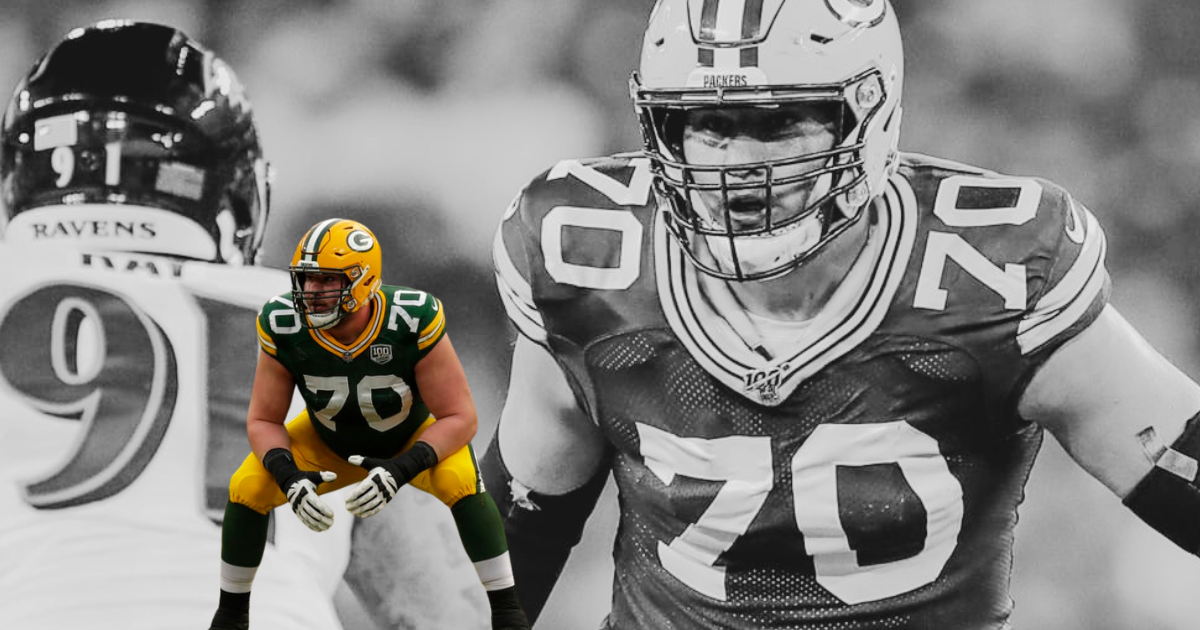
That’s the case for Alex Light, a little-used offensive lineman who nonetheless is something of a legend in his own right.
Light signed with the Packers as an undrafted free agent in 2018 and hung around for two seasons, appearing in 16 games as a reserve tackle and on special teams. But before that, he was, genuinely, an exceptional player everywhere he went.
A three-year letter winner in high school football, Light was a monster. As a junior, he already stood 6-foot-6 and weighed 295 pounds, which made him a force both on the football field and on the basketball court: his high school won the state title in both as a junior, and Light was an All-State selection. Coming into his crucial senior year, Light dropped weight to line up at 279 pounds. College coaches told him they wanted to see more mobility, so he slimmed down to accommodate their request — and so he could start on both sides of the ball. He did, and was named to the All-State team again.
Then, at the University of Richmond, Light appeared in five games as a freshman before ascending to the starting lineup as a sophomore. He never looked back, starting 37 games over his college career and earning all-conference honors as a senior. And during that senior season, he did it all for the Spiders, starting games at left tackle and left guard and also taking snaps at right tackle and even tight end.
The wild thing about professional sports is this: once you get to the professional level, virtually everyone has a story like Alex Light’s. There really aren’t players who come out of nowhere to find some secret reserve of athletic ability to become professional athletes. Most guys playing on Sundays have a long history of football dominance.
And that’s where the curse of fan knowledge comes in. Because fans can see all the stats that make stories like Light’s seem less impressive. But most don’t take the time to see how dominant he was on the road to getting there.
Unfortunately, the story for Light at the NFL level is short and not all that exciting. Thanks to snap count data, we can see that the only times Light really got into games were during blowouts or due to injuries. He did appear in quite a few games, all things considered, but only played more than 20 snaps on offense three times, and all three were losses.
The first was a 31-0 loss to the Lions to end the 2018 season. Light played 23 snaps, but that’s the kind of playing time you see in a meaningless game at the end of a season that’s already gone off the rails. And 2018 had gone off the rails in a big way. Mike McCarthy had been fired, and the Packers had already been eliminated from the playoffs. Then, early in the final game of the season, Aaron Rodgers was knocked out with a concussion, leaving a crew of backups to try to hold off the Lions. They didn’t.
Light’s second appearance came in 2019, when he filled in for an injured Bryan Bulaga during a tough loss to the Philadelphia Eagles. He struggled, allowing eight pressures to a tough Eagles defense in a seven-point Packers loss — exactly the kind of data point that modern fans can point to when showing what kind of player you were. That’s not necessarily enough to say Light caused the loss, but eight pressures in a tight game is enough to cause some doubt.
Light’s final significant appearance came later in 2019. Fresh off a bye week, the Packers traveled to San Francisco to face the 49ers. Things got off to a bad start when Aaron Rodgers fumbled on the Packers’ fifth offensive play and the 49ers recovered, punching in a touchdown one play later. Then, nine plays into the game, starting right tackle Bryan Bulaga hurt his knee, giving way to Light, who had to face a ferocious 49ers pass rush. He held up better this time, only giving up two pressures. The Packers had plenty of other problems, though, and fell to the 49ers by a score of 37-8.
Counting his work on special teams, Light would play just 17 more NFL snaps after the 49ers game, but that’s beside the point. For the vast majority of players, the achievement is making it to the NFL, and Light did. It’s not his fault that fans can dissect every snap of his career. But that’s their curse to bear. For Light, and for the people who watched him when he was still a high school athlete figuring out his way in the world, he’s the small-town boy who made it big. Everybody on an NFL field is, or at least a version of that. And that’s worth remembering.