
Shannon Clavelle
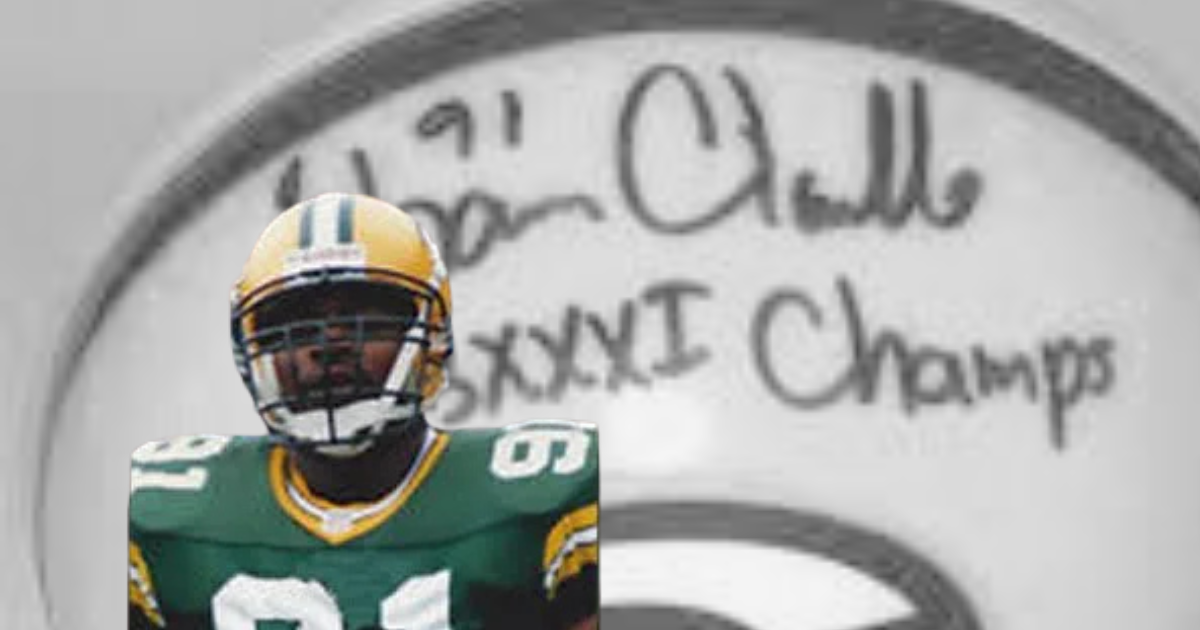
The NFL has transformed the sports memorabilia subculture. It’s never been easier to find, buy, or sell things connected to the game of football, from cards to jerseys to helmets to things you’ve never even imagined (a swatch of an end zone pylon from Super Bowl XLV, for instance, or a chunk of the Lambeau Field turf from the 1996 season).
In a very small corner of that internet subculture, you can find items autographed by a man named Shannon Clavelle.
As far as modern autographs go, Clavelle’s stands out for its tidy legibility. The loops of his letters are tall but neat, and his signature is invariably accompanied by two things: his number (91) and the inscription “SB XXXI Champs,” often appended with an exclamation point. Why wouldn’t you be exuberant about winning football’s ultimate prize?
The funny thing is, Clavelle didn’t play in Super Bowl XXXI. The official game book lists him as inactive for the big game, just as he was for each of the Packers’ playoff games that year, and just as he was for the final three regular season games of 1996.
Clavelle was, generously speaking, a role player on that 1996 team. But too often people fixate on the wrong word in that two word descriptor: the role may have been small, but Clavelle was still a player. He’d still put in the hard yards to make it to the NFL stage, and he acquitted himself well in the role he played.
A 6-foot-2, 287-pound defensive end out of Colorado, the Buffalo Bills took Clavelle in the sixth round of the 1995 NFL Draft. In that small moment, he was already brushing up against history. The Bills took Clavelle with the 185th pick, but a running back out of Georgia landed with the Denver Broncos at pick number 196. That back was Terrell Davis, the eventual MVP of Super Bowl XXXII.
That puts Clavelle in the unenviable position of being the answer to a league-wide trivia question that pops up every time a legendary player goes late in the draft: who did your team take instead of Terrell Davis? For the Bills, it was Clavelle, who didn’t even make it to the regular season with the team that drafted him. And lest you think the Packers are off the hook, they took a wide receiver named Charlie Simmons 12 picks ahead of Clavelle, and he never played a game in the NFL.
But that wasn’t uncommon in an era where late-round picks were even more of a flier than they are today. Given the circumstances of where he was drafted, it’s notable that Clavelle made it in the NFL at all. Five of the eight picks after Clavelle didn’t even play a down in the NFL — you can’t even find a page for them on Pro Football Reference. Their NFL careers functionally started and ended the moment they were drafted.
But Clavelle did more than that: he survived three NFL seasons.
As you might expect, he made little statistical impact in Green Bay, but he did make a splash play in one of the splashiest games of the Packers’ 1996 Super Bowl season.
The Packers came out blistering hot to open the 1996 season, outscoring the Buccaneers, Eagles, and Chargers by a combined score of 115 to 26. And in Week 3, as the Packers took the San Diego Chargers apart, Clavelle got in on the action.
With about four minutes to go in the fourth quarter, Clavelle and fellow defensive lineman Gabe Wilkins swarmed backup Chargers quarterback Sean Salisbury, bringing down the future ESPN analyst for half a sack apiece. It would be the only half sack of Clavelle’s career, and he joined what has to be a short list of NFL players whose only sack came against a future TV personality.
But as is the case with most role players, Clavelle faded away. He was released midway through the 1997 season, catching on with the Kansas City Chiefs for a single game before his career came to an end. Doubtless it was sooner than he’d have liked, as is the case for most professional athletes. But he was there: he played in 15 NFL games for the Packers and one for the Chiefs, and he sacked a future talking head in the process.
Even if he wasn’t on the active list for the Super Bowl, the work he put in made him a champ nonetheless, and he deserves to put that inscription on every piece of memorabilia someone asks him to sign.