
Willard Harrell
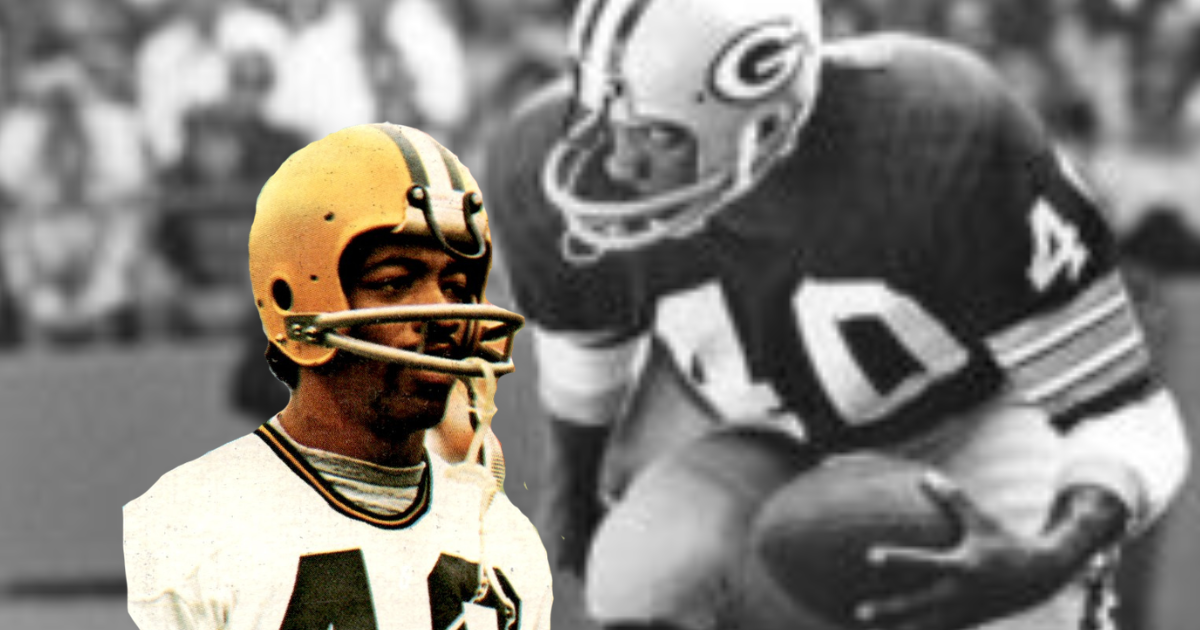
When asked who has the best passing season in Packers history, you might immediately think of Aaron Rodgers. And he certainly has a good case. In the 21st century, nobody’s done it quite the way he did.
If you’re a bit more old school, you might prefer Brett Favre, or maybe even Lynn Dickey, who bombed away for the Packers in the 1970s and 1980s. If you want pure efficiency, you could even go with Bart Starr, who led the NFL in passer rating four times — the same as Rodgers.
But if you wanted to go really off the map, you’d name little Willard Harrell, who put together a feat that we probably won’t ever see matched in Packers history again.
In 1975, Harrell did something truly wild: he threw three touchdowns on just five passing attempts. No other player in Packers history has done more with less on a season-long basis, and only three other players in NFL history have thrown at least three touchdowns in five or fewer attempts. LaDainian Tomlinson tossed three touchdowns in four attempts for the Chargers in 2006, and Keith Byars went four for four for four touchdowns for the Cardinals in 1990. But Harrell put up more yards than either of them, which is a funny twist on the stat, considering that Harrell was part of one of the shortest connections in football history.
Bart Starr selected Harrell with the 58th overall pick in the 1975 draft, bringing him to Green Bay out of the University of the Pacific. Starr was excited to nab Harrell, telling local reporters “He’s a game-breaker, a big play man. We hope he can play back there and be the kind of fellow who can break it open.”
Starr had good reason to think Harrell could be that kind of player. He certainly had game-breaking speed, reportedly running a 4.4-second 40-yard dash. He was certainly productive at Pacific, too, leaving as their all-time leading rusher. And he was certainly explosive: as a senior, he scored five touchdowns of 50 or more yards and also returned a kickoff 100 yards for a score.
The only question was this: is he too small?
Harrell measured just 5-foot-8 and weighed only 179 pounds when the Packers selected him, and even Starr didn’t think he could be an every down back. But Harrell showed quickly he could be explosive, and soon he’d make a connection with another vertically challenged Packers player.
That player was Steve Odom, who also stood just 5-foot-8 and actually was a bit lighter than his teammate at 173 pounds.
But height isn’t an issue if you can trick your opponent, and that’s exactly what the Packers, Harrell, and Odom did midway through the 1975 season. Three weeks in a row, the Packers asked Harrell to throw a pass. Three weeks in a row, Harrell found Odom for a touchdown.
The first came in Week 9. Facing the Lions in Detroit, John Hadl handed to Willard on what looked like a sweep to the left, only for Harrell to pull up and toss a 26-yard strike to Odom, who was all alone in the end zone.
A week later, Harrell and the Packers did the same thing headed the other direction. Hosting the Giants at Milwaukee County Stadium, Harrell swept to the right behind a pulling guard, then slammed on the brakes, flipped his hips, and hit Odom in the end zone. Odom made a nifty toe-tapping catch to notch a 23-yard score. In the process, Harrell became the first Packers player since 1945 to catch and throw a touchdown in the same game. As of the 2025 season, nobody has done it since.
Finally, Harrell and Odom completed the hat trick in Week 11 at home against the Chicago Bears. This time, they went back to the left, but the Bears seemed to be ready. When Harrell threw to the end zone, Odom had four Bears in relatively close proximity. None could close on the ball, though, and it floated softly into his hands.
Three throws. Three touchdowns. It was quite a stretch for Harrell, and arguably his best run of games as a member of the Packers. Had it not been for two misfired passes earlier in the season, Harrell’s passing season would truly have been perfect.
Unfortunately, that would be about as good as it got for Harrell in Green Bay. Concerns about his size proved to be well-founded. He never averaged more than 3.3 yards per carry in any of his three seasons with the Packers, and his game-breaking speed didn’t show up regularly enough as a receiver. After three seasons in Green Bay, the Packers cut him loose.
After a tryout, though, he’d land with the St. Louis Cardinals, where he’d play another seven seasons. He was never a big statistical contributor, but at the end of his NFL career, former Cardinals head coach Jim Hanifan summed up his career like this: “one of the smallest men to play in the National Football League in size and certainly one of the biggest in heart, desire and intelligence.”
That heart, desire, and intelligence would land Harrell in the Missouri Sports Hall of Fame — and it’s exactly the set of attributes you’d expect from a player who’s a bit undersized to run and block with the big boys of the NFL, but smart enough to know when to just throw over them.